
A working agent, not a source dump
A genuine tool-calling loop, a streaming REPL, session history, and multi-turn execution. Ported from the real Claude Code TypeScript architecture and shipped as a CLI you actually run.
ClawCodex is a token-efficient Python rebuild of Claude Code — 230K lines of pure Python. A genuine tool-calling loop, a streaming REPL, skills, and one runtime in front of Anthropic, OpenAI, Z.ai GLM, MiniMax, OpenRouter, and DeepSeek, where prefix-cache reuse makes long DeepSeek sessions over 200× cheaper to run.
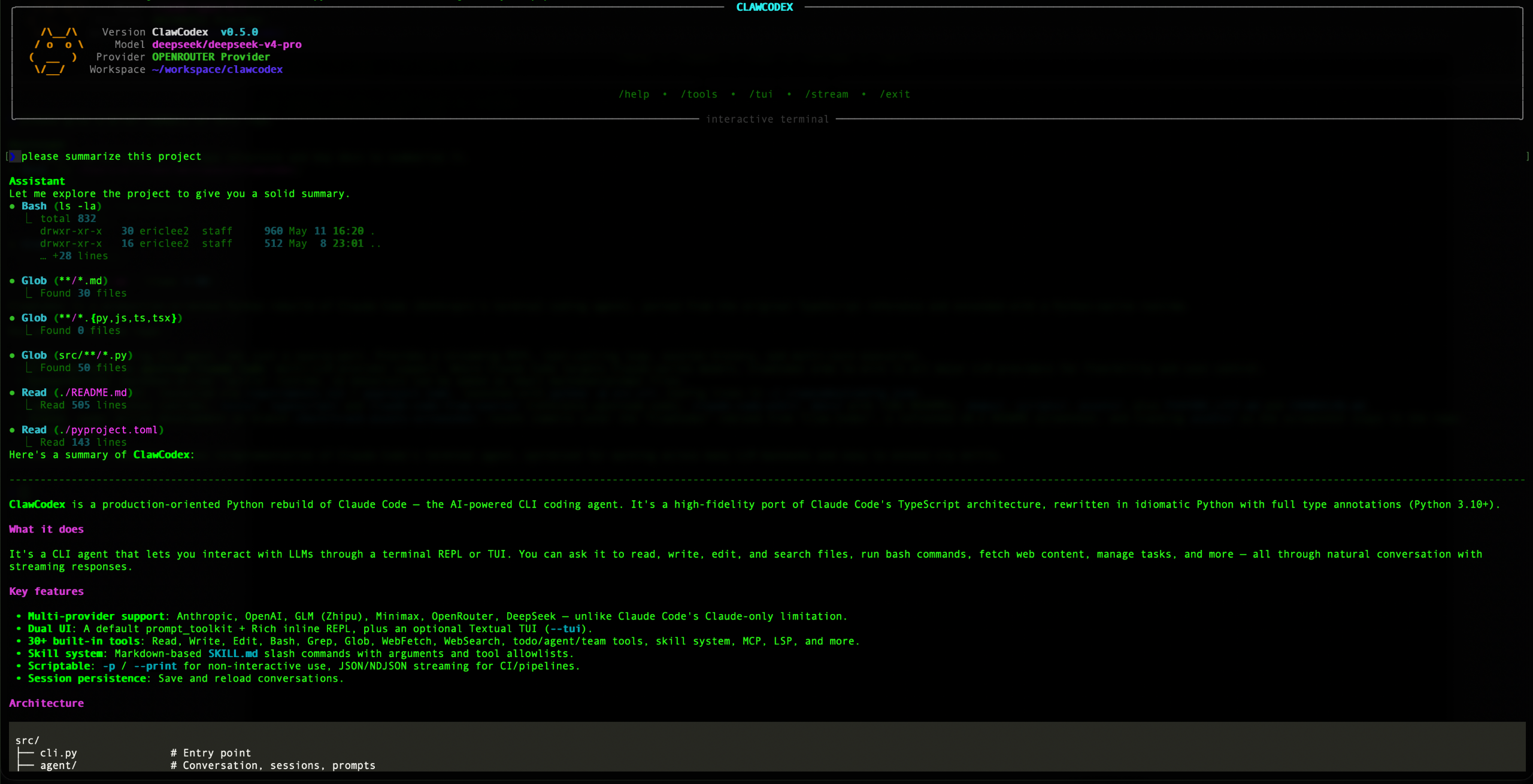
ClawCodex puts a real runtime around the model: a working loop, every provider, and code you can read and extend.
A genuine tool-calling loop, a streaming REPL, session history, and multi-turn execution. Ported from the real Claude Code TypeScript architecture and shipped as a CLI you actually run.
Claude Code targets Claude models only. ClawCodex puts Anthropic, OpenAI, Z.ai GLM, MiniMax, OpenRouter, and DeepSeek behind the same loop — so you swap vendor, region, and price tier without giving up tools or skills.
Idiomatic Python with full type hints, real test suites, and markdown-driven SKILL.md extensibility. Fork it, add a tool or a skill, and make it yours. MIT licensed.
Streaming, skills, permissions, sessions, MCP, and a scriptable headless mode — the same loop whichever model you point it at.
clawcodex web serves the browser client off the same clawcodex serve gateway the desktop app uses — one in-process agent, one config, one session store. A session started in the terminal resumes in a tab, and its Trajectory view accounts for every request: per-step tokens, TTFT, throughput, cache-hit rate, and model time separated from tool time.
clawcodex --nano trades the full tool surface for six tools and a ~2,000-token fixed payload instead of ~17,000. On terminal-bench 2.1 it solved the same tasks as default mode at 4.4× lower cost, and faster. Default-off and process-global: without the flag, nothing about your setup changes.
ClawCodex keeps the request prefix byte-stable so DeepSeek's prompt cache covers your whole system + tools + history span. Cache-hit input bills at about $0.0435 per 1M tokens, over 200× cheaper than Claude Fable 5, so long agentic sessions cost pennies. The longer you code, the more you save.
True API streaming for direct replies plus richer streaming during tool-driven loops. Toggle live output with /stream and re-render clean Markdown with /render-last.
Markdown-based SKILL.md slash commands with named arguments and per-skill tool limits. Project skills and user skills, loaded from .clawcodex/skills.
An inline prompt_toolkit + Rich REPL with history, tab completion, and multiline input. Launch the Textual TUI any time with clawcodex --tui or /tui.
Plan (read-only), acceptEdits, dontAsk, and an explicit bypass for sandboxes. The REPL, TUI, and headless -p mode all honor the same gates.
Save and reload conversations locally. auto_save writes each session; max_history caps retained turns. Everything stays on your machine.
Model Context Protocol tools and resources, plus pre/post tool-use lifecycle hooks for shell, prompt, agent, and HTTP automation.
Run -p for one-shot prompts, with --output-format json or stream-json for pipes, CI, and agent-to-agent workflows.
A TS-parity Read pipeline sniffs magic bytes and resizes to API limits. @-mention an image to inline it, with Anthropic-to-OpenAI block translation for vision-capable backends.
Swap vendor, region, and price tier without giving up tools or skills. All 30 providers ship today.
Seven native integrations (DeepSeek, Anthropic, OpenAI, Gemini, Z.ai GLM, MiniMax, OpenRouter) plus an OpenAI-compatible gateway registry and local servers that need no key — 30 in all. Add any other OpenAI-compatible endpoint with a custom base_url; keys resolve from config or the vendor's standard env var (e.g. TOGETHER_API_KEY).
# point a single run at a different backend
clawcodex --provider deepseek --model deepseek-v4-pro
clawcodex --provider zai --model glm-5.2 -p "refactor utils.py"Read code, call tools behind permission gates, leave real evidence, and resume across sessions.
You type in the REPL or pipe a prompt with -p. Plan mode is read-only by default.
The selected provider streams the reply; tool calls overlap with the stream.
Reads, edits, bash, and web run behind permission gates, leaving real evidence.
Results feed the next turn. Sessions save locally so long work survives.
The heartbeat that orchestrates model calls and tool execution.
30+ tools: read files, run bash, search the web, drive sub-agents and MCP.
Background workflows and agent orchestration, journaled and resumable.
A bootstrap layer and an app layer, kept independent by design.
Relevance scanning over project, user, and team CLAUDE.md files.
Lifecycle events with shell, prompt, agent, and HTTP executors.
Full SWE-bench Verified split (499 instances), both agents driven by Gemini 2.5 Pro under one standardized harness.
Same CLI you just installed, same agent loop, same tools. No hand-edits.
A mini CRM with contacts, deals, a dashboard, and a full test suite.
demos/crm-app
Profile, network, jobs, and messaging in a familiar feed layout.
demos/linkedin-app
A browser voxel sandbox with terrain, mining, a HUD, and player controls.
demos/minecraft-app
Animated hero, live countdown, host nations, and 16 stadiums. Built with GLM-5.2.
demos/wc26-intro
v1.6.0 ships two things that pull in opposite directions on purpose. ClawCodex Web puts the agent in a browser tab — a third front end on the same backend, with a Trajectory view that accounts for every token and millisecond of a run. Nano mode goes the other way: six tools and a ~2K-token payload, measured 4.4× cheaper than default at equal quality on Terminal-Bench 2.1.
A three-column shell (session tree | conversation | details) with streaming replies, collapsible reasoning, live tool cards, permission approvals as a composer takeover, a prompt queue for follow-ups typed mid-turn, a context meter, slash-command completion, session resume, and light/dark/system themes. Run clawcodex web --build. It is not a second server: it is clawcodex serve with the built bundle mounted on it, so a browser drives the same in-process agent, the same gateway, and the same durable sessions as the TUI and the desktop app.
The forensic view of the same session: every model request and tool call in order, a three-lane timeline that switches between equal-width operations (the run's shape) and real elapsed durations (where the time went), per-step tokens, TTFT, throughput and cache-hit rate, and a Summary / Preview / Raw inspector. Model time and tool time are reported separately — "41s" is not actionable, "41s of model, 22s of tools" says which half to go look at.
Six tools instead of 24+, a ~300-token system prompt instead of ~7,000, one-to-three-sentence tool docs, no per-turn injections, and /eco on: a ≈2,000-token fixed payload against the default's ≈17,000. On terminal-bench 2.1 with deepseek-v4-flash, both A/B tasks passed in both modes — nano at $0.0042 versus $0.0186 total, 4.4× cheaper at equal quality, and faster. Default-off; without the flag nothing changes.
A truncation guard fails tool calls carried by a max_tokens-cut response instead of executing possibly-truncated arguments; compaction summaries end with cumulative read/modified path ledgers so the working set survives a compact; and Edit gains a multi-edit ladder with fuzzy near-miss rescue that still preserves untouched lines byte-for-byte. Nano never activates the advisor — a two-model loop is not what a nano benchmark measures.
No CLA. No sponsor lockouts. Issues triaged in the open, releases cut from main, and the maintainer reads everything. Bring a real test and prose that tells the reviewer what you were thinking.