
ClawCodex vs Raw DeepSeek Usage: Our Cost Benchmarks and Optimization Wins
Same tokens, different bill. We benchmark disciplined, cache-warm DeepSeek usage through ClawCodex against raw, hand-rolled API calls — and the prompt-shape, routing, and output-cap wins that actually lower spend.
Executive Summary
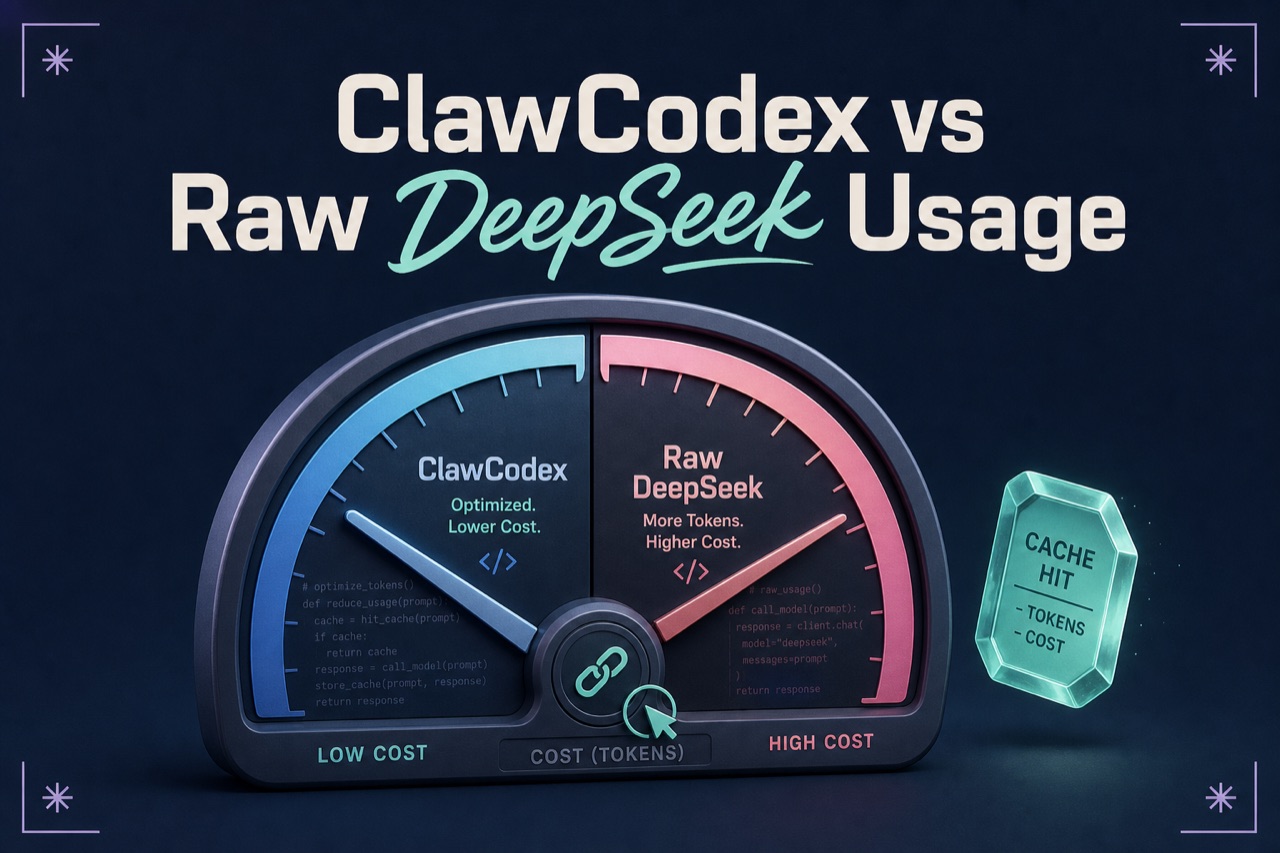
Comparing the real cost of running a coding agent on DeepSeek through ClawCodex versus calling the raw DeepSeek API yourself is not as simple as saying one is cheaper. The per-token rates are identical — they are the same DeepSeek models. The difference is discipline.
ClawCodex is an open-source (MIT) coding agent that defaults to DeepSeek and keeps its request prefix byte-stable across turns, so DeepSeek's prompt cache covers the whole system + tools + history span. 'Raw DeepSeek usage' means assembling and sending those requests yourself. Nothing stops a hand-rolled loop from being efficient — but in practice it tends to break the cache, over-generate output, and retry blindly, so it drifts toward the expensive end of the very same price sheet. The economics of both come down to input tokens, output tokens, cache-hit rate, model choice, and how carefully prompts are put together; ClawCodex's job is to make the cheap path the default one.
Our benchmark model shows how much that discipline is worth. Using DeepSeek's official pricing, a representative coding task with 1,000,000 input tokens and 50,000 output tokens costs about:
| Scenario | Estimated cost per task |
|---|---|
| deepseek-chat, 80% cache-hit input (ClawCodex-style) | $0.165 |
| deepseek-chat, no cache (naive raw usage) | $0.325 |
| deepseek-reasoner, 80% cache-hit input | $0.3315 |
| deepseek-reasoner, no cache | $0.6595 |
On the same workload, keeping the cache warm nearly halves the deepseek-chat bill ($0.325 to $0.165) and cuts the deepseek-reasoner bill from $0.6595 to $0.3315. A $20 budget of DeepSeek spend therefore buys roughly 121 cache-warm deepseek-chat tasks, but only about 62 cold ones — keeping the prefix stable almost doubles what the same money buys, and a byte-stable prefix is exactly what ClawCodex maintains for you.
But per-token cost is only part of the story. Coding quality, retries, latency, failure modes, governance, and human-review time can easily outweigh raw token savings. Independent evaluation from CAISI/NIST found that DeepSeek V3.1 improved a lot over earlier DeepSeek models but still lagged behind leading U.S. reference models on software-engineering benchmarks. So the most reliable recommendation is disciplined routing, not a single model:
- Let ClawCodex drive deepseek-chat for everyday, cache-friendly coding — repo analysis, test generation, first-pass edits, documentation, and batch automation.
- Escalate harder debugging, architecture, concurrency, and security-sensitive tasks to deepseek-reasoner or a stronger provider, instead of sending every task through the most expensive option.
- Measure cost per accepted patch, not cost per prompt.
- Preserve cacheable prompt prefixes, cap unnecessary output, log real usage, and keep humans in the approval loop.
The biggest optimization win does not come from a clever provider trick. It comes from making the disciplined path automatic — which is the whole reason ClawCodex exists.
Introduction
A coding agent is a lot like a junior developer with an unlimited coffee budget: useful, fast, occasionally brilliant, and surprisingly expensive if you let it loop all night.
That is why the question 'what does this actually cost?' has become more than theoretical. Developers are no longer asking whether AI can write code. They are asking how to keep AI coding workflows from quietly turning into a runaway infrastructure bill.
At first glance, raw DeepSeek looks unbeatable: its API pricing is explicit and low, especially when context caching hits. But once you move beyond a few hand-written prompts and into real coding-agent behavior — repo context, repeated tool calls, retries, tests, patch reviews, multi-file edits — the gap between the sticker price and the actual bill widens. A token-billed API can feel cheap until verbose outputs, missed cache opportunities, and repeated failed attempts erase the savings. The right question is not 'Which model has the lowest sticker price?' It is 'Which workflow produces accepted code changes at the lowest total cost and risk?'
This article treats the comparison as a transparent benchmark model, not a claim of hidden proprietary results. DeepSeek publishes explicit API pricing and cache behavior; ClawCodex is open source, so the way it shapes requests is inspectable too. Using those public sources, we can build a practical cost model, identify where the savings come from, and show why the same DeepSeek tokens cost so differently depending on how the agent around them is built.
The short version: raw DeepSeek gives you a low sticker price and explicit metering. ClawCodex is the agent that turns that low sticker price into a low bill — by keeping the cache warm, routing each task to the cheapest sufficient model, and capping wasteful output. The comparison is not really ClawCodex against DeepSeek. It is disciplined DeepSeek usage against naive DeepSeek usage.
Market Insights
The AI coding market is shifting from novelty to cost engineering. A year or two ago, the main question was whether AI coding assistants could generate useful patches. Now the more mature question is whether they can do that repeatedly, safely, and at a reasonable cost.
That shift matters because coding agents behave differently from chatbots. A chatbot answers a question. A coding agent may read files, summarize context, propose patches, run tests, inspect failures, rewrite code, ask for more context, and repeat the process. One ticket can turn into dozens of model calls. A repo-wide refactor can turn into millions of tokens. A CI-connected agent can turn into a cost center.
Raw DeepSeek belongs to the usage-based API world. DeepSeek publishes token prices for deepseek-chat and deepseek-reasoner, including separate rates for cache-hit input tokens, cache-miss input tokens, and output tokens. Its API also exposes fields such as prompt_cache_hit_tokens and prompt_cache_miss_tokens, which makes cost optimization unusually concrete: you can see whether your prompt structure is helping or hurting. That observability is a major advantage for automation-heavy workflows — if a batch job costs more than expected, you can inspect token usage, cache misses, output size, retries, and model routing.
DeepSeek's context caching is the main lever. According to DeepSeek's documentation, caching is enabled by default. When requests share overlapping prefixes, those prefixes can be served from cache; cache hits are cheaper than cache misses, and the API response reports how many prompt tokens hit or missed. DeepSeek describes caching as 'best-effort,' so it is not guaranteed — but for coding workflows it maps naturally to repeated repo context, stable task instructions, coding conventions, dependency summaries, and multi-turn debugging.
In our representative model, the difference is substantial. For deepseek-chat, a task with 1,000,000 input tokens and 50,000 output tokens costs about $0.325 with no cache. If 80% of input tokens hit cache, the same task costs about $0.165 — roughly a 49% reduction. For deepseek-reasoner, the modeled cost drops from about $0.6595 to $0.3315 under the same cache-warm assumption.
This is why 'prompt shape' is now a cost strategy. A stable repository preamble at the beginning of the prompt is not just cleaner — it can also be cheaper. Keeping conventions, architecture notes, dependency summaries, and task instructions in a consistent prefix improves cache reuse. Constantly rewriting the prompt header, reordering sections, or starting fresh sessions when you do not need to reduces cache effectiveness. This is the single biggest place a hand-rolled integration leaves money on the table — and the single biggest thing ClawCodex handles for you, by moving every per-request-volatile section (timestamps, environment, plan-mode notes) to a trailing block so the cached prefix never breaks.
The market is also learning that the cheapest token is not always the cheapest patch. CAISI/NIST evaluated DeepSeek models against U.S. reference models and found that DeepSeek V3.1 improved substantially over R1 but still trailed leading U.S. models on software-engineering benchmarks. In the report's summary table, DeepSeek V3.1 scored 54.8 on SWE-bench Verified and 78.5 on Breakpoint, while OpenAI GPT-5 scored 63.0 and 98.0 respectively, and Anthropic Opus 4 scored 66.7 and 92.3.
That does not make DeepSeek a bad coding model. It means teams should benchmark end-to-end outcomes. If a cheaper model needs three retries and a senior engineer has to untangle subtle regressions, the token savings may vanish. On the other hand, if DeepSeek can handle 80% of routine work cheaply and reliably, it can materially cut spend while reserving frontier models for the hardest cases. That is an argument for a routing layer — which is exactly what ClawCodex's multi-provider runtime and /advisor mode provide.
Reports from the developer community reinforce this split. Users comparing direct DeepSeek usage against aggregator pricing often focus on whether cache-hit pricing is passed through. Others describe routing simple tasks to cheaper models and escalating harder bugs. These reports are anecdotal, but they point to a real operational lesson: the path that keeps native cache-hit pricing and lets you escalate deliberately wins on long-running coding workflows.
Security and governance are also central. Sending proprietary code to any external API requires data-governance review. DeepSeek's cache is described as user-isolated and temporary, but that does not remove the need to decide what may leave your machine. CAISI/NIST also reported alignment and censorship concerns in DeepSeek models, which may matter for public-sector, geopolitical, or policy-sensitive organizations. The direction of the market is clear: teams are moving from 'Which AI coding tool should we use?' to 'How do we build a governed model-routing system that balances cost, quality, latency, and risk?'
How ClawCodex Changes the Math
ClawCodex matters here because it is not a rival to DeepSeek — it runs on DeepSeek (and five other providers) and is engineered to capture the cache-warm economics above by default. The benchmark's cheap column is not a special offer; it is what disciplined usage looks like, and ClawCodex makes that discipline the path of least resistance.
Concretely, ClawCodex is an open-source coding agent for the terminal — a Python rebuild of Claude Code with a real tool-calling loop, a streaming REPL, skills, sessions, and permission modes. Three of its design choices map directly onto the benchmark:
- Byte-stable prefix to cache hits. ClawCodex keeps the system + tools + history prefix byte-for-byte stable across turns, so DeepSeek's prompt cache covers it. That is what moves you from the cold column to the cache-warm column on the same price sheet.
- /advisor to difficulty routing. ClawCodex can pair a cheap worker model with an expensive reviewer consulted only at decision points — roughly 6x cheaper than running the expensive model throughout. That is the 'escalate deliberately' rule, built in.
- /cost to observability. ClawCodex surfaces the live prompt-cache hit-rate and USD cost, so you can see whether your prefix is actually being cached — the same primitive raw DeepSeek exposes through prompt_cache_hit_tokens, but read out for you per session.
Raw DeepSeek, by contrast, gives you the primitives but leaves the engineering to you. A CI bot, repo analyzer, documentation generator, or batch refactoring assistant needs hard budgets, stable prefixes, output caps, and logs. You can absolutely build those controls yourself against the bare API — but every team that does is rebuilding a slice of what ClawCodex already is. The honest framing is: use the raw API directly when you want a thin, fully custom integration and are happy to own the caching and routing discipline; reach for ClawCodex when you would rather that discipline come for free.
The cost benchmark makes the boundary concrete. Using DeepSeek's published pricing, our representative coding-agent task assumes 1,000,000 total input tokens, 50,000 output tokens, a cache-warm case with 80% cache-hit input and 20% cache-miss input, and a cold case with 100% cache-miss input. We use deepseek-chat for ordinary coding work and deepseek-reasoner for harder debugging or design work:
| Scenario | Formula | Estimated cost |
|---|---|---|
| deepseek-chat, cache-warm | 0.8M x $0.07 + 0.2M x $0.27 + 0.05M x $1.10 | $0.165 |
| deepseek-chat, no cache | 1.0M x $0.27 + 0.05M x $1.10 | $0.325 |
| deepseek-reasoner, cache-warm | 0.8M x $0.14 + 0.2M x $0.55 + 0.05M x $2.19 | $0.3315 |
| deepseek-reasoner, no cache | 1.0M x $0.55 + 0.05M x $2.19 | $0.6595 |
Translated into a fixed budget, a $20 chunk of DeepSeek spend stretches very differently depending on whether the cache stays warm:
| Scenario | Tasks per $20 of DeepSeek spend |
|---|---|
| deepseek-chat, cache-warm (ClawCodex-style) | ~121 tasks |
| deepseek-chat, no cache (naive raw usage) | ~62 tasks |
| deepseek-reasoner, cache-warm | ~60 tasks |
| deepseek-reasoner, no cache | ~30 tasks |
The same $20 buys nearly twice as many deepseek-chat tasks when the cache stays warm. That gap — 121 versus 62 — is not a discount you negotiate; it is a property of how the prompts are shaped, and keeping that prefix stable across a long agentic session is precisely what ClawCodex does without you thinking about it.
There is one more lever worth naming. 'Cost per prompt' is misleading, because a cheap bad patch is not actually cheap. 'Cost per accepted patch' accounts for retries, review time, test failures, reverted changes, and escalation — it is the metric that best matches AI usage to engineering outcomes. A model that generates five bad attempts is not cheap; a model that solves the task in one clean patch may cost less overall even at a higher per-token price. ClawCodex helps on both axes: it lowers the per-token cost through caching, and it raises the accept rate through deliberate escalation and permission-gated, reviewable changes.
Where you still need more than DeepSeek can give — a production incident, a security-sensitive patch, a complex architecture decision — ClawCodex's multi-provider runtime lets you point the same loop at Anthropic, OpenAI, Z.ai GLM, MiniMax, or OpenRouter without rebuilding your workflow. A good hybrid architecture might look like this:
| Task type | Recommended path |
|---|---|
| Simple CRUD changes | ClawCodex on deepseek-chat (cache-warm) |
| Test generation | ClawCodex on deepseek-chat |
| Documentation updates | ClawCodex on deepseek-chat |
| Repo summarization and repeated code analysis | ClawCodex on deepseek-chat, cache-aware prompts |
| Ambiguous bugs | Escalate to deepseek-reasoner (or /advisor) |
| Architecture decisions | deepseek-reasoner or a frontier provider, with human review |
| Security-sensitive code | Strong model + plan mode + strict approval |
| CI automation | ClawCodex headless (-p) with hard spend caps |
| Production agent workflows | Governed setup: logging, budgets, fallbacks, approvals |
The takeaway is not 'ClawCodex beats DeepSeek' — that sentence does not even type-check, because ClawCodex runs on DeepSeek. The takeaway is that the cheap column of the benchmark is only cheap if something keeps the cache warm, routes by difficulty, and caps the output. You can build that yourself on the raw API, or you can let the agent do it.
Actionable Tips
The most useful optimization wins are operational, not theoretical. Here is how to turn the benchmark into lower bills and better outcomes — whether you run ClawCodex or hand-roll the API yourself.
1. Shape prompts for DeepSeek context caching
DeepSeek's cache works on overlapping prefixes, so structure matters. Put stable context at the beginning of the prompt and avoid unnecessary changes to that prefix. A strong coding-agent prompt often begins with a repository summary, architecture overview, coding conventions, dependency notes, test commands, formatting rules, and security constraints — then the task instructions. If those sections stay stable across related calls, they are more likely to benefit from cache reuse. Practical rules:
- Keep the repo preamble stable.
- Avoid changing the system prompt unless necessary.
- Place volatile task details after stable context.
- Use one session per task when continuity matters.
- Track prompt_cache_hit_tokens and prompt_cache_miss_tokens.
- Calculate cache-hit percentage per task, not just globally.
The benchmark shows why: in the deepseek-chat model, moving from no cache to 80% cache-hit input cuts the representative task cost from $0.325 to $0.165 — nearly half off without changing the model. If you run ClawCodex, this is the default; its byte-stable prefix and trailing-volatile-block layout are designed to keep that percentage high, and /cost shows you the live hit-rate so you can confirm it.
2. Route by difficulty instead of defaulting to the strongest model
Running every coding task through a reasoning model is usually wasteful. Many development tasks are routine: add a test, update a docstring, rename a field, implement a straightforward endpoint, fix a lint error, or adjust a UI copy string. Use deepseek-chat for CRUD changes, tests, docs, simple refactors, and obvious bug fixes; reserve deepseek-reasoner for ambiguous failures, multi-file debugging, architecture tradeoffs, concurrency bugs, and security-sensitive reasoning; and reach for a frontier model when correctness matters more than marginal token cost.
In our model, 100 cold deepseek-reasoner tasks cost about $65.95. But if 80 easier tasks use cache-warm deepseek-chat and 20 harder tasks use cache-warm deepseek-reasoner, the modeled cost is about $19.83 — roughly a 70% reduction. The lesson is simple: do not buy a crane to move every cardboard box. (ClawCodex's /advisor automates the pattern: a cheap worker does the bulk, an expensive reviewer is consulted only at decision points.)
3. Put a 'reasoner budget' on each ticket
Reasoning models are useful, but they can become an expensive habit. Give each ticket a limited escalation budget: start with deepseek-chat; if tests fail twice, escalate once to deepseek-reasoner; if the reasoner cannot resolve it within one or two turns, require human review; and for production-critical code, skip the cheaper attempts and route directly to the stronger path. This keeps agents from burning tokens on low-confidence loops and makes costs easier to predict.
4. Cap output length aggressively
Output tokens are often more expensive than input tokens. DeepSeek's official pricing lists output at $1.10 per million for deepseek-chat and $2.19 per million for deepseek-reasoner — higher than both cache-hit and cache-miss input rates. Avoid prompts that invite essays when you need patches. Ask for minimal diffs, concise explanations, test commands only, no repeated code unless necessary, and no full-file rewrites unless required. A coding agent that explains every obvious line of code is not being helpful; it is sending you an invoice with prose.
5. Measure cost per accepted patch, in both paths
You cannot optimize what you do not measure. Log model, input tokens, output tokens, cache-hit tokens, cache-miss tokens, latency, retries, task type, final outcome, and whether the patch was accepted. Then normalize to a single metric: cost per accepted patch. That metric beats token cost because it captures hidden waste — a model that generates five bad attempts is not cheap, and a model that solves the task in one clean patch may cost less overall even at a higher per-token price. ClawCodex's /cost gives you the token and USD side of this; your code review gives you the accept-rate side.
6. Benchmark with real tickets before standardizing
A proper benchmark should include at least 30–50 representative tasks across bug fixes, refactors, test generation, documentation, dependency updates, repo analysis, and multi-file changes. Use the same repo snapshot, the same task prompt, and the same acceptance tests across providers. Measure total tokens, cache-hit and cache-miss tokens, output tokens, wall-clock time, retries, human-review minutes, test pass/fail, accepted-patch rate, reverted-patch rate, and security-sensitive actions. Calculate exact cost from official token prices. Do not let a toy benchmark decide a production workflow — coding assistants often look great on simple tasks and reveal their real cost on messy, real-world tickets.
7. Treat agent execution as a security boundary
Coding agents can execute commands, modify dependencies, inspect files, and interact with developer environments. They should be governed like execution environments, not chat windows. Run them under least privilege: keep API keys as secrets (ClawCodex stores them in ~/.clawcodex/config.json, obfuscated at rest, and never in prompts or logs), use plan mode for read-only investigation, require approval before write or shell actions, separate read-only review from write-capable patching, scan patches before merge, and audit logs. ClawCodex's permission modes (plan, acceptEdits, dontAsk) exist precisely to make these gates the default rather than an afterthought.
8. Review DeepSeek data and governance implications
DeepSeek states that cache entries are user-isolated and temporary, usually cleared within hours to days after they are no longer used. That is useful, but organizations still need to review whether proprietary code may be sent to the API, whether secrets could appear in prompts, whether customer data is involved, jurisdiction and data-handling requirements, model-alignment concerns, and public-sector or regulated-industry restrictions. CAISI/NIST reported censorship and alignment concerns in DeepSeek models. For routine coding tasks that may not matter; for policy-sensitive, geopolitical, public-sector, or compliance-heavy work, it may — which is another reason ClawCodex keeps every other provider one flag away.
9. Build a fallback path
Any single provider can hit rate limits, downtime, or budget caps, and an agent stuck retrying a failing path is expensive even before it produces bad code. A practical setup runs ClawCodex on DeepSeek as the cost-efficient default, keeps a stronger provider one flag away for hard failures, and wires in budget caps, retry limits, and clear escalation to human review. Because ClawCodex puts six providers behind one runtime, that fallback is a configuration choice rather than a second integration. Resilience is part of cost optimization.
Conclusion
ClawCodex and raw DeepSeek are not really competitors. Raw DeepSeek is a low-priced, well-instrumented token API. ClawCodex is the open-source agent that runs on top of it (and five other providers) and is engineered to turn that low sticker price into a genuinely low bill.
Raw DeepSeek is the right choice when you want a thin, fully custom integration and are happy to own the caching, routing, and budgeting discipline yourself. Its official pricing and cache-hit reporting make it well suited to high-volume, cache-friendly workloads — and with stable prompt prefixes and smart routing, costs can fall to cents per representative coding task in the benchmark model. Its tradeoffs are quality variance versus leading coding models, governance review, data-handling concerns, and the engineering you have to do to keep the cache warm.
ClawCodex is the right choice when you would rather that discipline come built in. It defaults to DeepSeek, keeps the prefix byte-stable for cache hits, escalates deliberately with /advisor, meters spend in /cost, gates writes behind permission modes, and falls back to any other provider with a flag. It is still alpha and ships weekly, so benchmark it on your own tickets before betting production-critical work on it — but as the agent layer of a cache-aware DeepSeek stack, it is exactly where the optimization wins live.
The optimization win is not 'ClawCodex beats DeepSeek' or 'DeepSeek beats everyone.' It is building a workflow that sends each task to the cheapest sufficient model, preserves cacheable context, limits wasteful output, logs real outcomes, and treats AI coding as an engineering system rather than a magic text box. Raw DeepSeek gives you the parts. ClawCodex assembles them for you.
References
- ClawCodex on GitHub
- DeepSeek API Pricing Details
- DeepSeek Context Caching Guide
- CAISI/NIST Evaluation of DeepSeek AI Models Report
- Reddit: Are DeepSeek API prices much cheaper direct?
- Reddit: DeepSeek from the official API has such an insane cost profile
- Axios: Microsoft explores a lower-cost DeepSeek or open-source option for Copilot