
Designing a Low-Cost DeepSeek Stack: ClawCodex Strategies for Frugal Teams
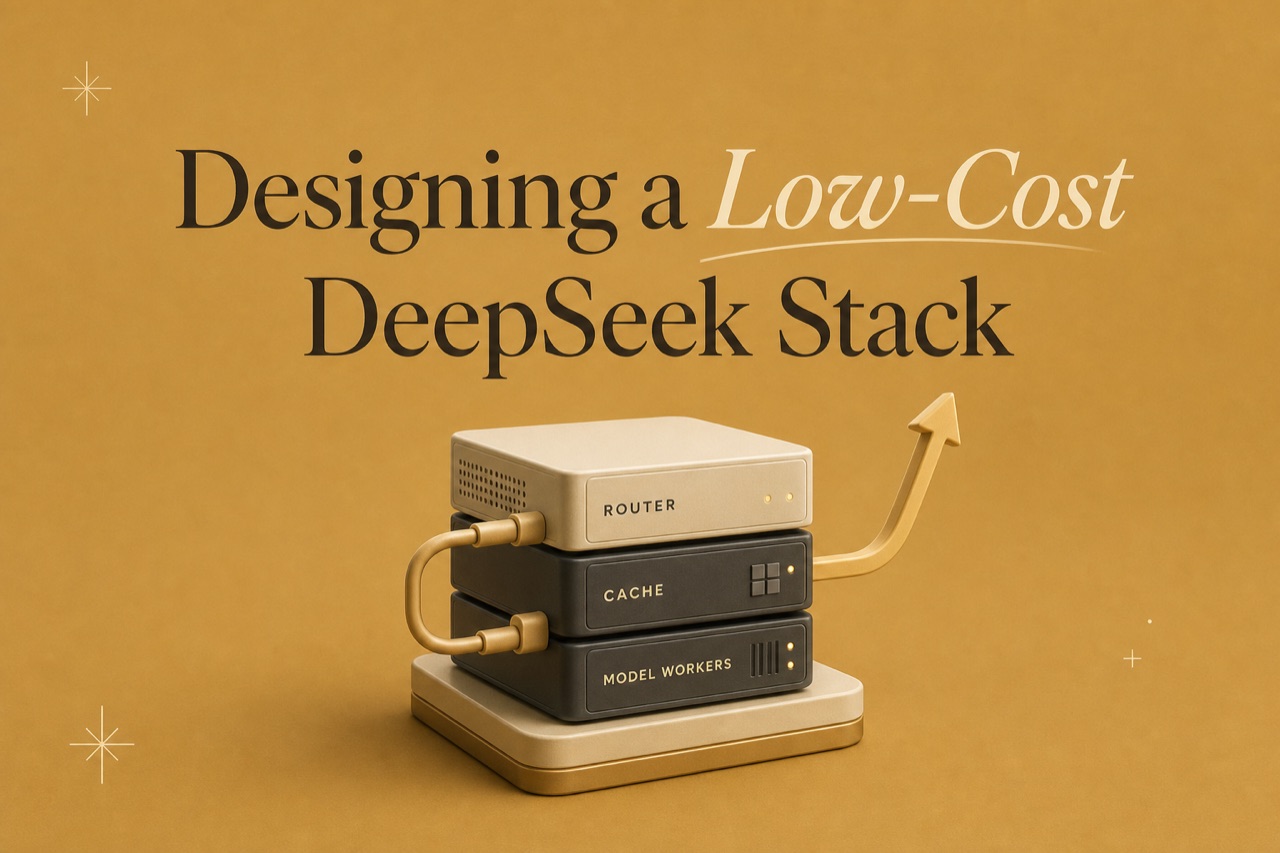
A disciplined playbook for frugal teams: send the cheapest acceptable task to the cheapest acceptable model, preserve DeepSeek cache hits, route by risk, cap the spend — and let ClawCodex run the stack, without ignoring governance or data rules.
Executive Summary
A low-cost DeepSeek stack should not start with 'more agents,' a complicated orchestration layer, or a premium-model reflex. It should start with one simple rule: send the cheapest acceptable task to the cheapest acceptable model, preserve cache hits, and never let low token prices override data-governance rules.
For most frugal engineering teams, the practical stack looks like this:
- Use DeepSeek's direct API as the budget anchor for low-risk coding and automation work.
- Route routine tasks to DeepSeek V4 Flash first.
- Escalate only selected tasks to DeepSeek V4 Pro or another approved premium model.
- Design prompts so repeated context stays in the stable prefix and benefits from DeepSeek context caching.
- Keep sensitive code, credentials, customer data, regulated information, and high-risk business material away from any provider path that has not been approved by legal and security teams.
- Let ClawCodex run the stack — DeepSeek by default, byte-stable prefixes for cache hits, and one runtime in front of every provider — while you keep the routing, spend caps, and data rules around it.
The economics are hard to ignore. DeepSeek's official pricing lists V4 Flash at $0.14 per 1M uncached input tokens, $0.0028 per 1M cache-hit input tokens, and $0.28 per 1M output tokens. V4 Pro is listed at $0.435 per 1M uncached input tokens, $0.003625 per 1M cache-hit input tokens, and $0.87 per 1M output tokens. For a small team using 20M input tokens and 5M output tokens in a month, with 70% of inputs hitting cache, V4 Flash inference would cost roughly $2.28 at those listed rates.
But cheap inference is not the same thing as a safe, reliable system. Agent loops can burn tokens. Tool output can blow up context. A 'cheap' model can turn expensive if it retries the same bad patch five times. And when customer data or proprietary source code is in the mix, privacy policies matter more than forum anecdotes.
The right strategy is disciplined and, in the best way, a little boring: DeepSeek API access + cache-aware prompts + task routing + spend caps + human approval gates + data governance. ClawCodex is a natural fit for that setup — it is an open-source agent that already defaults to DeepSeek, preserves cache hits with a byte-stable prefix, and routes across providers — so the discipline lives in the workflow, not in a pile of bespoke glue.
Introduction
The easiest way to overspend on AI coding tools is to mistake 'cheap tokens' for a 'cheap workflow.'
A small team plugs an agent into a repository. The first few runs feel magical: issues summarized, tests generated, docs updated, refactors proposed. Then the agent starts looping on a failing test. It pastes the same logs back into the prompt. It asks for full-file context again. It rewrites a patch that CI has already rejected. By the end of the day, the model was cheap, but the workflow was not.
That is the real challenge for frugal teams adopting DeepSeek and open-source coding agents such as ClawCodex. The goal is not simply to find the lowest token price. The goal is to build a system where low-cost inference really does lower engineering cost, without creating avoidable security, compliance, or terms-of-service problems.
DeepSeek's current API pricing makes serious coding-agent experimentation unusually accessible. Its context caching can sharply cut the cost of repeated prompt prefixes, which is exactly what many development workflows produce: the same system instructions, repo summaries, coding standards, tool schemas, and output formats repeated across many tasks. That makes DeepSeek especially interesting for small engineering teams, indie builders, internal tooling groups, and operations teams that want AI assistance without premium-model bills.
But the stack needs a clear division of labor.
DeepSeek should be the primary low-cost inference layer for approved, low-risk work. DeepSeek V4 Flash should handle routine tasks first. DeepSeek V4 Pro should be saved for harder reasoning, architectural planning, and repeated-failure cases where cheap retries stop being cheap. Other approved providers, or local models, should handle sensitive or regulated workloads when required.
ClawCodex fits this picture well. It is an open-source (MIT) terminal coding agent — a Python rebuild of Claude Code with a genuine tool-calling loop, a streaming REPL, skills, sessions, and permission modes. It defaults to DeepSeek and keeps the request prefix byte-stable across turns, so DeepSeek's prompt cache covers the whole system + tools + history span, and cache-hit input bills at a fraction of the normal rate. Because it also puts Anthropic, OpenAI, Z.ai GLM, MiniMax, OpenRouter, and DeepSeek behind one runtime, the risk-based routing below is a flag, not a rebuild. It is still alpha and ships weekly, so evaluate it before betting production-critical work on it — but it is built for exactly this kind of cost-disciplined workflow.
So the question is not 'Can we make AI coding free?' The better question is:
Market Insights
AI coding tools are moving through a familiar cycle. First, teams chase capability: better code generation, longer context, stronger reasoning, more autonomous agents. Then the invoices show up, and the conversation shifts to unit economics.
The current market gives teams more options than ever. There are premium hosted models from OpenAI, Anthropic, and Google. There are lower-cost hosted APIs such as DeepSeek. There are open-weight models that can be self-hosted. There are routers and compatibility layers that promise one interface across many providers. There are local tools that mimic familiar API shapes. Each category solves a different problem, and each comes with a different cost profile.
The most important market insight for frugal teams is that model price is only one part of system cost. A coding-agent stack can spend money in at least seven ways:
- Input tokens
- Output tokens
- Repeated context from long-running sessions
- Tool calls and tool results
- Retries after bad outputs
- Orchestration, hosting, and routing overhead
- Human review time after unreliable changes
DeepSeek is attractive because it cuts into the first three, especially when teams use the official API and design prompts around context caching. DeepSeek says context caching is enabled by default and requires no code changes. If later requests share overlapping prefixes with previous requests, repeated portions can be billed as cache hits. That is a major advantage for coding workflows, where the same repo instructions and policy blocks are often reused. The listed DeepSeek prices make the contrast clear:
| Model | Uncached input | Cache-hit input | Output |
|---|---|---|---|
| DeepSeek V4 Flash | $0.14 / 1M tokens | $0.0028 / 1M tokens | $0.28 / 1M tokens |
| DeepSeek V4 Pro | $0.435 / 1M tokens | $0.003625 / 1M tokens | $0.87 / 1M tokens |
For comparison, OpenAI lists GPT-4.1 mini at $0.40 per 1M input tokens, $0.10 per 1M cached input tokens, and $1.60 per 1M output tokens. Anthropic lists Claude Sonnet 4.6 at $3 per 1M input tokens and $15 per 1M output tokens. These are not perfect apples-to-apples comparisons — models differ in quality, tooling, terms, latency, and enterprise controls — but they show why DeepSeek is getting attention from cost-sensitive teams.
A simple example makes the point. Assume a small team uses:
- 20M input tokens per month
- 5M output tokens per month
- 70% cache-hit rate on input tokens
On DeepSeek V4 Flash:
- 14M cached input tokens x $0.0028/M = $0.0392
- 6M uncached input tokens x $0.14/M = $0.84
- 5M output tokens x $0.28/M = $1.40
- Total inference cost: approximately $2.28.
On DeepSeek V4 Pro with the same mix:
- 14M cached input tokens x $0.003625/M = $0.05075
- 6M uncached input tokens x $0.435/M = $2.61
- 5M output tokens x $0.87/M = $4.35
- Total inference cost: approximately $7.01.
That same 20M input / 5M output workload without cache would cost about $16.00 on GPT-4.1 mini at the listed rates, and about $135.00 on Claude Sonnet 4.6. Those estimates leave out web search, tool-use overhead, retries, hosting, storage, orchestration, and human review time, but they explain why DeepSeek direct API access has become a serious budget lever.
However, the market is not only about cost. It is also about trust, jurisdiction, maturity, and operational fit. DeepSeek's privacy policy states that it may collect prompts, inputs, uploaded files, feedback, chat history, photos, voice inputs, and other content users provide to the model and services. It also says personal data may be processed to improve and develop services and technology, including machine-learning models and algorithms. NIST's CAISI evaluation has reported security shortcomings and censorship risks in evaluated DeepSeek models. The U.S. House Select Committee on the CCP and CSIS have also raised broader concerns around data, censorship, security, and digital sovereignty.
That does not mean DeepSeek is unusable. It means the market is splitting into two questions:
- Where is DeepSeek economically attractive? Low-risk, repeat-heavy, cache-friendly coding and automation tasks.
- Where is DeepSeek not automatically appropriate? Customer data, secrets, regulated workloads, sensitive proprietary code, legal material, financial data, government data, or any workflow where the provider path has not been approved.
This is why the best low-cost strategy is not 'use DeepSeek for everything.' It is route intelligently. A router can simplify access, centralize billing, provide fallback across providers, and add observability or policy controls. That may be worth paying for. But if the team mostly uses DeepSeek and depends heavily on DeepSeek's native context caching, direct API access may be cheaper. Community reports from Reddit and coding-agent discussions repeatedly point to native DeepSeek caching as a reason official API access can beat intermediaries on long-running coding workflows. Those reports should be treated as anecdotal, not authoritative, but they line up with the underlying economics.
Finally, local hosting sounds attractive but is rarely the cheapest path for small teams. DeepSeek's Hugging Face model card describes V4 Flash and V4 Pro as open-weight and provides local-run options, but these are large mixture-of-experts models: V4 Flash is listed as 284B total parameters with 13B activated parameters, and V4 Pro as 1.6T total parameters with 49B activated parameters. Running models of that size can cost more than hosted inference unless a team already has suitable hardware, high utilization, or strict privacy requirements.
For most frugal teams, the winning market posture is hybrid:
- Hosted DeepSeek API for low-risk, cost-sensitive work.
- Approved premium providers for sensitive or high-stakes workloads.
- Small local models for redaction, preprocessing, or private helper tasks.
- Full local DeepSeek hosting only when privacy or existing GPU economics justify it.
- ClawCodex as the open-source agent that runs the stack — DeepSeek by default, cache-aware, multi-provider.
Where ClawCodex Fits
A low-cost DeepSeek stack still needs an agent to actually run the work — read files, call tools, apply patches, and stay inside your budget and permission rules. That is what ClawCodex is.
ClawCodex is an open-source (MIT) coding agent for your terminal: a Python rebuild of Claude Code with a real tool-calling loop, a streaming REPL, a markdown-driven skill runtime, resumable sessions, MCP, and lifecycle hooks. It runs entirely on your machine, with no telemetry, and you bring your own API key. Three things make it a good fit for frugal teams:
- DeepSeek by default. DeepSeek-V4-Pro is wired in as the default model, with its 1M-token context window registered and a per-model prompt-cache hit-rate plus USD cost surfaced in /cost.
- Prefix-cache reuse. ClawCodex keeps the request prefix byte-stable across turns, so DeepSeek's automatic prompt cache covers the entire system + tools + history span. Per-request-volatile sections (env, the mutable memory body, plan mode) move to a trailing system-reminder after the history, so the cached prefix never breaks.
- One runtime, every provider. Anthropic, OpenAI, Z.ai GLM, MiniMax, OpenRouter, and DeepSeek sit behind the same loop, so the risk-based routing in this guide is a configuration choice, not a migration.
It also ships an /advisor mode that pairs a cheap worker model with an expensive reviewer consulted only at decision points — roughly 6x cheaper than running the expensive model alone — which is the 'escalate deliberately' principle from this guide, built in. Permission modes (plan, acceptEdits, dontAsk) and a scriptable headless mode give you the gates and automation hooks a governed stack needs.
ClawCodex is still alpha and ships weekly. Treat it the way you would treat any fast-moving tool: pin to a known-good commit for anything important, keep your API keys in its local config, and review before wiring it into production automation.
A sensible architecture for frugal teams has five layers:
| Layer | Recommended role |
|---|---|
| Primary model layer | DeepSeek V4 Flash through the official DeepSeek API for routine, low-risk coding and automation |
| Escalation layer | DeepSeek V4 Pro for harder reasoning, architectural planning, difficult debugging, and repeated-failure tasks |
| Compliance-sensitive fallback | OpenAI, Anthropic, Google, or local models for workloads requiring approved provider terms or stronger data controls |
| Agent runtime | ClawCodex driving the loop — tool calls, edits, sessions, and permission gates — pointed at whichever model the task deserves |
| Governance layer | Budget caps, prompt redaction, request logging, retry limits, test gates, and human approval rules |
This framing keeps the stack honest. DeepSeek provides the low-cost inference economics. ClawCodex provides the agent loop and keeps the prefix cache-friendly. Routing keeps expensive models focused on tasks that justify them. Governance prevents runaway agents.
Actionable Tips
The best low-cost AI stack is not the one with the longest model list. It is the one where the boring controls are in place before the exciting demos start. Start with these practical moves.
1. Use DeepSeek V4 Flash as the default for low-risk work
Most teams should start with V4 Flash for routine tasks:
- Documentation drafts
- Issue triage
- Changelog summaries
- Test generation
- Small code edits
- Simple refactors
- Log summarization
- Internal scripts
- Low-risk automation
DeepSeek's official API page lists V4 Flash with a 1M-token context length, tool calls, JSON output, chat prefix completion, and fill-in-the-middle completion in non-thinking mode. That makes it a natural default for cost-sensitive workflows. But do not confuse 'default' with 'only.' If V4 Flash fails repeatedly, generates unstable patches, or struggles with multi-file reasoning, escalation can be cheaper than piling on more retries. A practical routing policy looks like this:
| Workflow | Default model | Escalate when | Budget logic |
|---|---|---|---|
| Documentation, summarization, issue triage | DeepSeek V4 Flash (non-thinking) | Output affects customers, legal commitments, or public messaging | Cheapest path for low-risk text work |
| Test generation, small edits, simple refactors | DeepSeek V4 Flash (thinking / high effort) | Tests fail twice, or the diff touches auth, payments, security, or data access | Cheap retries are useful, but only up to a limit |
| Architecture planning, incident analysis, hard bugs | DeepSeek V4 Pro | Pro still fails, or the task is safety/compliance sensitive | Pay for reasoning where failure cost justifies it |
| Security review, compliance, proprietary/customer data | Approved provider or local model | Never route sensitive content to unapproved providers | Lowest token price is irrelevant if data risk is unacceptable |
DeepSeek's Hugging Face model card states that V4 Flash can approach Pro reasoning performance with a larger thinking budget, but is naturally behind on pure knowledge tasks and the most complex agentic workflows. That supports a simple rule: Flash first, but not forever.
2. Design prompts for cache hits
This is the biggest cost lever many teams miss. DeepSeek context caching rewards stable prefixes. That means the most reused content should appear at the beginning of the prompt and remain byte-for-byte stable whenever possible. A cache-friendly prompt layout looks like this:
[Stable system policy]
[Stable coding standards]
[Stable repo architecture summary]
[Stable tool schema / output contract]
[Stable examples]
[Variable task request]
[Variable files / diffs / logs]
[Variable user constraints]
The wrong pattern is to regenerate everything every time:
[New timestamp]
[New session ID]
[Rewritten system prompt]
[Re-summarized repo context]
[Changed tool descriptions]
[Task request]
[Logs]
That kind of prefix churn undercuts caching. DeepSeek's documentation says cache hits require matching overlapping prefixes. If the prefix changes with every request, the system has less reusable context to match. To improve cache hits:
- Keep system instructions stable.
- Put repo standards before task-specific details.
- Avoid timestamps in the prompt prefix.
- Avoid randomly reordered tool descriptions.
- Do not rewrite the repo summary every turn.
- Keep output schema consistent.
- Put variable logs, diffs, and user instructions near the end.
- Version your prompt templates intentionally instead of editing them casually.
This is exactly what ClawCodex does for you on DeepSeek: it keeps the system + tools + history prefix byte-stable and pushes per-request-volatile data (timestamps, environment, plan-mode notes) into a trailing block, so the cached prefix stays intact turn after turn. Think of the prompt prefix like a reusable shipping container. If you repaint, resize, and relabel it on every trip, the logistics system cannot treat it as the same container.
3. Measure before optimizing
Before building a complicated router, run a one-week baseline. Log:
- Model used
- Task type
- Input tokens
- Output tokens
- Cache-hit tokens
- Cache-miss tokens
- Number of retries
- Tool calls
- Wall-clock time
- Test status
- Human review outcome
- Whether escalation was needed
This gives you the data to answer practical questions: which tasks are cheap and reliable on V4 Flash, which tasks burn retries, how much output agents generate, whether cache hits are actually happening, which prompts are unstable, and which workflows need human approval earlier. DeepSeek charges by token count, so token logging is not optional if you care about budget forecasting.
4. Cap output tokens aggressively
In coding workflows, output tokens can dominate cost. Even with very low input prices, an agent that prints full files, verbose explanations, repeated logs, and large diffs can waste money quickly. Set defaults such as:
- Return only the changed function unless asked for the full file.
- Summarize logs before analysis.
- Do not repeat unchanged code.
- Use unified diff format for patches.
- Limit explanations to the reasoning needed for review.
- Ask before producing large generated files.
DeepSeek V4 Flash output is listed at $0.28 per 1M tokens, and V4 Pro output at $0.87 per 1M tokens. Those are low rates compared with many premium models, but an uncontrolled agent can still produce unnecessary output, especially in loops. Tool verbosity also matters. Anthropic's pricing documentation explicitly notes that tool definitions, tool-use blocks, tool-result blocks, command outputs, errors, and large file contents add tokens. The exact accounting differs by provider, but the operational lesson is universal: tools are not free just because the model is cheap.
5. Add hard stop conditions before agents touch real code
A frugal agent stack needs a brake pedal. Use rules like:
budget:
  monthly_team_limit_usd: 50
  daily_team_limit_usd: 5
  per_task_limit_usd: 0.50
max_model_retries: 2
max_agent_steps: 8
max_output_tokens_default: 4000
require_human_approval_for:
  - production_write
  - dependency_upgrade
  - auth_or_crypto_change
  - database_migration
  - customer_data_access
Useful stop conditions include:
- Stop after two failed patch attempts.
- Stop after two identical failing tests.
- Stop after one unsafe file access.
- Stop if the diff touches authentication, cryptography, billing, or permissions.
- Stop if the agent requests customer data.
- Stop if tool output exceeds a defined token threshold.
- Stop if the model asks to modify too many files at once.
OpenAI's rate-limit documentation explains that limits help prevent abuse, ensure fair access, and manage infrastructure load. Internal limits serve the same purpose: they prevent runaway agents and surprise bills.
6. Write a data-routing policy
Do this before sending real work through the stack. A simple data policy should define:
| Data class | Allowed route |
|---|---|
| Public docs and open-source examples | DeepSeek V4 Flash allowed |
| Internal non-sensitive engineering tasks | DeepSeek V4 Flash, or V4 Pro if approved |
| Proprietary source code | Approved route only, based on company policy |
| Credentials, secrets, API keys | Never send; redact or block |
| Customer records | Approved enterprise provider or local-only path |
| Regulated data | Legal/security-approved route only |
| Security incidents | Approved provider or local-only path |
| Government, healthcare, financial, or legal data | Explicit approval required |
DeepSeek's privacy policy says it may collect prompts, inputs, uploaded files, feedback, and chat history, and may process personal data to improve and develop services and technology. That should be enough to justify a written policy. The practical rule is simple: if the data would cause a serious incident if mishandled, do not send it to a provider path just because the model is inexpensive.
7. Use local models for redaction and preprocessing
Local hosting of DeepSeek V4 may not be the cheapest option for small teams, but smaller local models can still play an important role. Use local processing to:
- Detect and redact secrets.
- Remove customer identifiers.
- Summarize logs before sending them externally.
- Classify task sensitivity.
- Strip unnecessary files from context.
- Enforce prompt policies before provider calls.
This hybrid approach preserves much of the cost advantage of hosted DeepSeek while reducing avoidable data exposure. ClawCodex helps here too: point its OpenAI-compatible provider at a custom base_url for a local vLLM, SGLang, or Ollama endpoint, and run redaction or preprocessing locally before any hosted call.
8. Run ClawCodex with guardrails
If ClawCodex is the agent running your stack, configure it for frugality and safety:
- Keep DeepSeek as the default provider and let routine work land on it.
- Use permission modes — plan (read-only) first, then acceptEdits — so the agent earns write access.
- Cap retries and agent steps so a stuck loop cannot keep burning tokens.
- Watch /cost (prompt-cache hit-rate and live USD) and turn on /advisor for hard tasks.
- Keep API keys in ~/.clawcodex/config.json, not in prompts or logs.
- It is alpha and ships weekly — pin a known-good version for anything important, and review before production automation.
9. Decide when a router is worth the markup
Direct DeepSeek API access is likely attractive when:
- Most tasks go to DeepSeek.
- Workflows reuse stable prompt prefixes.
- Native context caching creates meaningful savings.
- The team can handle basic provider integration.
- Governance can be implemented internally.
A router may be worth it when:
- You need multi-provider fallback.
- You want centralized billing.
- You need one API surface across several models.
- You want built-in observability or limits.
- Your team values operational simplicity more than the minimum token cost.
Do not assume the router is cheaper because it simplifies access. Also do not assume direct API is better if your team lacks the tooling to monitor spend, enforce policy, and handle failures.
10. Avoid 'cheap model absolutism'
A cheap model is not always the cheapest solution. Escalate when:
- The task fails twice.
- The model keeps making the same mistake.
- The diff spans many files.
- The change touches security, auth, payments, or data access.
- The model needs deep architectural context.
- Human review time is becoming expensive.
- CI failures are repetitive and uninformative.
Sometimes the lowest-cost move is to pay for a stronger model for one clean attempt instead of asking a cheaper model to stumble through five bad ones. ClawCodex's /advisor mode automates exactly this: a cheap worker does the bulk of the work and an expensive reviewer is consulted only at decision points, about 6x cheaper than running the expensive model throughout.
Conclusion
A low-cost DeepSeek stack is not a hack. It is an operating discipline. The winning pattern for frugal teams is clear:
- Use DeepSeek direct API as the primary budget anchor.
- Send routine, low-risk work to DeepSeek V4 Flash.
- Escalate selectively to DeepSeek V4 Pro or another approved provider.
- Preserve context cache hits with stable prompt prefixes.
- Cap retries, output tokens, tool calls, and agent steps.
- Add human approval for risky write operations.
- Keep sensitive data out of unapproved provider paths.
- Let ClawCodex run the stack — DeepSeek by default, byte-stable prefixes for cache hits, multi-provider routing, and permission gates.
DeepSeek's pricing can make AI-assisted development dramatically more affordable, especially for repeat-heavy coding workflows. But the teams that benefit most will not be the ones that simply swap in a cheaper model. They will be the ones that redesign the workflow around caching, routing, governance, and measurable outcomes.
ClawCodex is built for exactly this: an open-source, multi-provider coding agent that defaults to DeepSeek and is engineered around prefix-cache reuse. It is still alpha and shipping weekly, so evaluate it before production-critical use — but as the agent layer of a disciplined, cache-aware DeepSeek stack, it is right at home.
The best stack is therefore pragmatic: DeepSeek for low-cost approved inference, premium or local models where risk demands it, ClawCodex running the loop, and governance everywhere. That is how frugal teams turn inexpensive tokens into genuinely inexpensive engineering.
References
- DeepSeek API Pricing
- DeepSeek Context Caching Documentation
- DeepSeek Privacy Policy
- DeepSeek V4 Flash Model Card (Hugging Face)
- OpenAI GPT-4.1 mini Pricing
- OpenAI Rate Limits Guide
- Anthropic Claude Pricing Documentation
- Google Gemini API Pricing
- NIST: CAISI Evaluation of DeepSeek AI Models
- U.S. House Select Committee on the CCP: DeepSeek report
- CSIS: DeepSeek and Digital Sovereignty
- OpenRouter API Limits Documentation
- ClawCodex on GitHub